

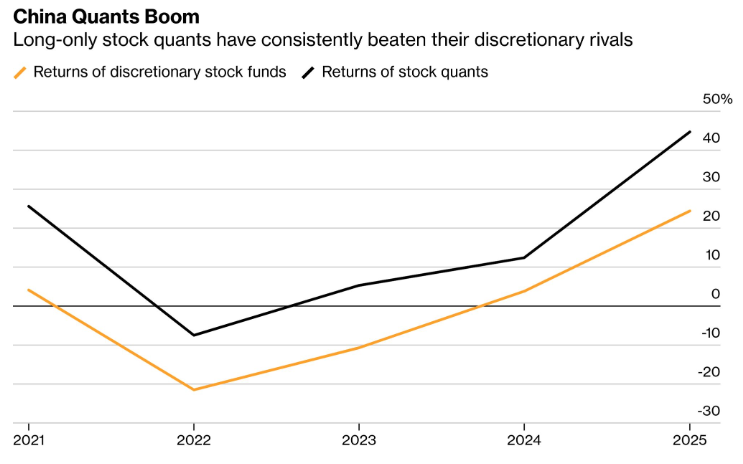
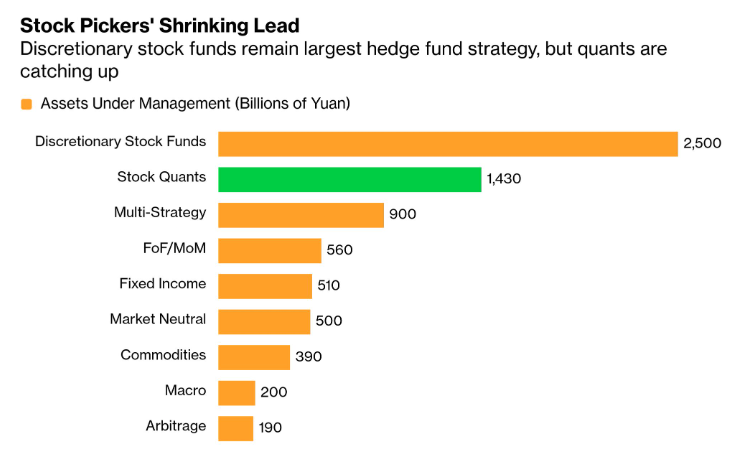
China quant funds are attracting record capital as AI-driven strategies are delivering outstanding returns. Ubiquant raised 2.6 billion yuan in under two hours for a new fund in May, while long-only stock quants gained 44.7 percent in 2025, beating discretionary rivals by 20.3 percentage points. The sector’s Assets Under Management (AUM) have more than doubled in under a year to exceed 2.6 trillion yuan.
China quant funds: The AI Advantage
Chinese investors have traditionally favored star managers over computer models. But that changed last year when the machines trounced humans by more than 20 percentage points.
“Quants’ breadth in covering thousands of stocks has prevailed over the depth of research pursued by discretionary long-only managers. Quants have finally become mainstream, and there’s no turning back,” said Chen Xu, COO of BigQuant.cn.
Leading quant managers like High-Flyer, Minghong Investment, and Ubiquant have aggressively scaled operations with AI-enhanced strategies. High-Flyer, for instance, saw massive returns of around 56 to 57 percent in 2025. The whole sector is blowing up, too; by April 2026, 71 quant managers had already hit that 10 billion yuan AUM milestone, with 11 new firms joining that elite group in April alone. It’s pretty incredible growth.
The comeback: Lingjun’s 70 percent return
Look at Ningbo Lingjun Investment Management for a wild comeback story. Back in early 2024, their trading models messed up, causing a massive sell-off that led to exchange penalties and a real crisis for the firm. But they didn’t just sit there; they tightened up their risk controls/rules and started using faster signals alongside their usual long-term models. It totally paid off, too; they ended up crushing the competition with an average return of over 70 percent in 2025, and leading the rankings among top quants.
Lingjun now aims to expand AUM by 20 to 40 billion yuan after avoiding new investors for two years. The turnaround captures a broader industry shift: top-tier quants have built a “technological moat” that smaller firms find difficult to cross.
The regulatory rollercoaster
By 2026, the sector was back, not only recovered, but it’s on its feet now and absolutely thriving. As of April 2026, 71 quant managers had hit that 10 billion yuan AUM milestone, with 11 new firms joining the club just that month. Adding more frenzy to this jump, there were 98 managers with over 50 billion yuan under management, handling a massive 2.3 trillion yuan altogether. But, of course, regulators are keeping a close eye on these activities.
And, something to have in mind is that, in June 2026, the State Council issued new guidelines to tighten up on how private funds are monitored, specifically keeping a close watch on quant and algorithmic trading. The big takeaway? The government is cool with quants helping out with market efficiency, but they are not going to let anyone get away with excessive leverage or causing market chaos.
For anyone in the Web3 or crypto space keeping an eye on how China’s quant scene is evolving, it’s pretty obvious that regulation is still the wild card that could change everything.