



Anthropic warned that AI could advance beyond governments’ ability to manage if advanced systems begin building their own successors, calling for global mechanisms to slow or pause frontier development before risks outrun society’s readiness to respond.
In an essay titled “When AI builds itself,” The Anthropic Institute said AI systems are already accelerating AI development inside Anthropic, with Claude now handling a growing share of engineering and research work that was once performed almost entirely by humans.
The company said recursive self-improvement, in which an AI system can autonomously build a more capable successor, has not yet arrived and is not inevitable, but warned that it could come sooner than most institutions expect.
When AI starts taking over the development cycle
Anthropic said the AI development process has shifted rapidly over the past five years, from humans writing code and documents directly to chatbots helping with short snippets, coding agents editing files and autonomous agents running work on their own.
The company said that shift, if taken far enough and supported by enough computing power, points to a future in which AI systems may be able to build and train new models themselves.
Such a shift, Anthropic said, could become one of the most significant developments in technology, opening major possibilities in science, healthcare and other fields, while also raising the risk of losing human control over systems that are increasingly difficult to monitor, secure or shape.
Anthropic framed the issue as a practical governance challenge rather than a distant philosophical concern.
If AI begins to accelerate its own improvement cycle, the company said, the world will need stronger systems to evaluate frontier models, coordinate among developers and decide when the pace has become too difficult to manage.
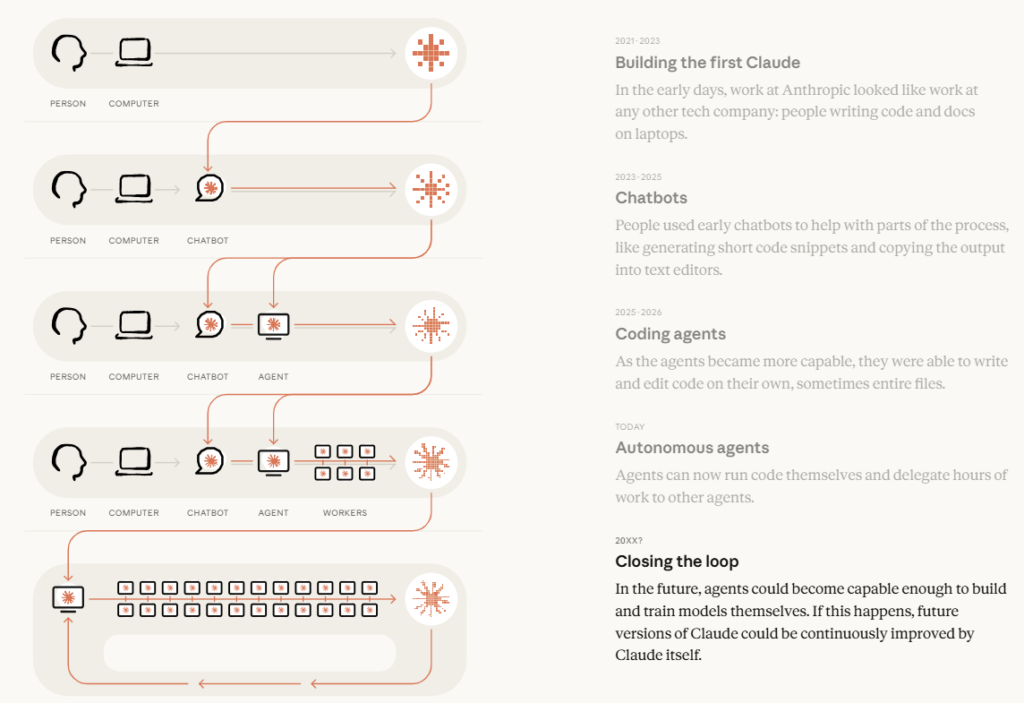
Claude now writes more than 80 percent of Anthropic’s code
Anthropic pointed to its own internal operations as evidence that the acceleration is already underway.
As of May 2026, more than 80 percent of the code merged into Anthropic’s production codebase was authored by Claude, compared with low single digits before Claude Code launched in research preview in February 2025.
Anthropic said its engineers are now merging far more code than before, with the typical engineer merging eight times more code per day in the second quarter of 2026 than in 2024.
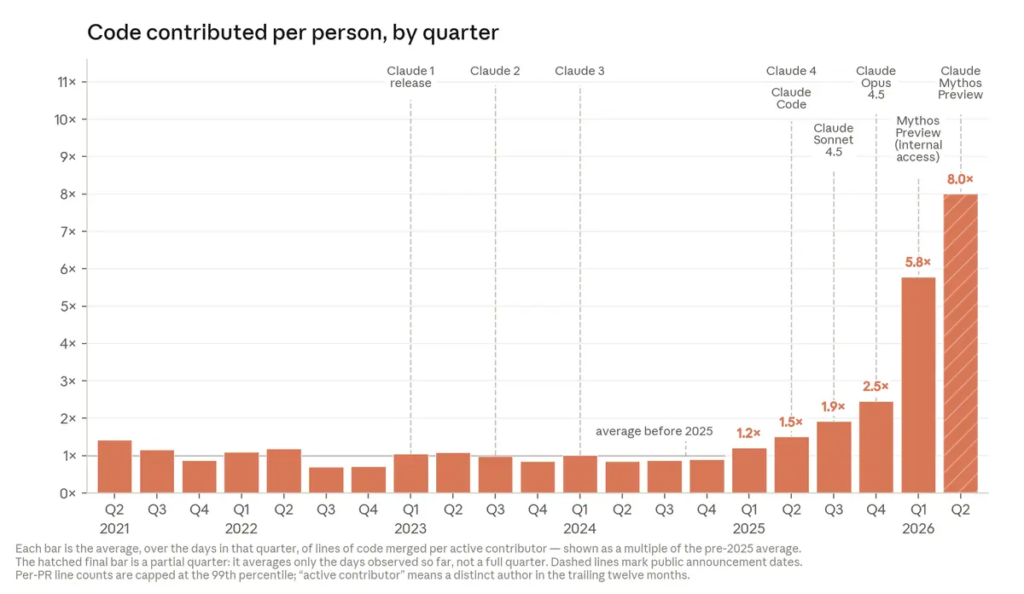
The company noted that lines of code are not a perfect productivity measure because they show volume, not quality, but argued that the increase still points to a major acceleration in technical work.
Anthropic said the shift became visible in 2025, when Claude began running code instead of only suggesting snippets for engineers to copy and paste, and became sharper in 2026 as models started working autonomously over longer time horizons.
The company also said Claude is increasingly able to solve underspecified engineering problems, with humans setting the goal while the model works out the method.
On the most open-ended coding tasks, Claude’s success rate reached 76 percent in May 2026, up 50 percentage points in six months.
Research judgment remains the key gap
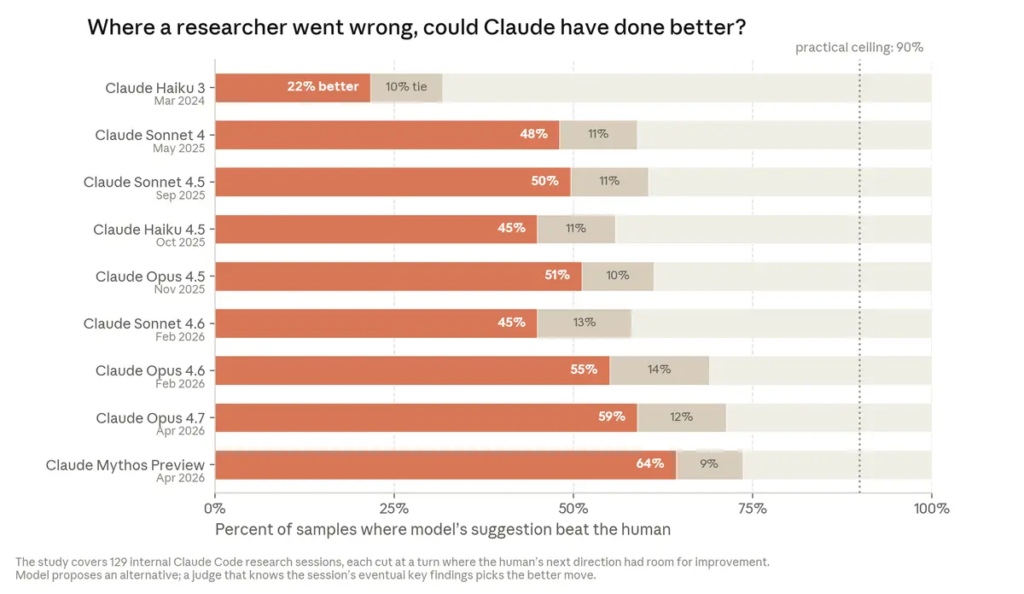
In experimental work, Anthropic said Claude can already match or outperform skilled humans when executing a clearly defined experiment, but still shows gaps when deciding which goals matter, which results should be trusted and which paths should be abandoned.
The company described that judgment as the main line separating today’s AI assistants from a future system that could autonomously design its own successor.
For now, humans still hold the advantage in seeing the bigger picture and choosing which research direction is worth pursuing.
Still, Anthropic said Claude’s research abilities are improving quickly.
In one internal test, Anthropic gave Claude a piece of code used to train a small AI model and asked it to make that code run faster without breaking the required accuracy checks.
Claude Opus 4 averaged a roughly 3x speedup in May 2025, while Claude Mythos Preview reached about 52x by April 2026.
A skilled human researcher, Anthropic said, would need four to eight hours to reach 4x in the same setup.
The company also cited an open-ended AI safety experiment in which Claude-powered agents were asked to investigate whether a weaker model could reliably supervise a stronger one.
Two human researchers recovered around 23 percent of the performance gap over about a week, while the agents recovered 97 percent over 800 cumulative hours and roughly $18,000 in compute.
Anthropic said the result had limits, since humans still selected the problem and designed the scoring rubric. Within those boundaries, however, the agents planned and ran the experiments themselves.
Three paths: slowdown, acceleration or self-building AI
Anthropic described three scenarios for what comes next. In the first, AI progress slows or stalls when current methods reach a limit, computing power becomes a bottleneck, energy and chip supply fail to keep pace, or another barrier emerges.
Even then, the company said today’s AI systems would still reshape the economy as they spread through companies and institutions.
In the second scenario, AI labs continue seeing compounding efficiency gains, but humans remain responsible for setting research direction and judging results.
Anthropic said this could allow small companies to perform the work of organizations many times larger, reshaping knowledge work and government services while also enabling harmful uses, including surveillance and large-scale influence operations.
The third scenario is full recursive self-improvement, where AI systems become capable of designing, training and refining their own successors.
In that world, Anthropic said the pace of AI progress may depend increasingly on compute availability, while humans shift toward oversight, validation and verification of an expanding “virtual lab” run by AI systems.
Anthropic said it does not know what such a world would look like, especially if human labor stops being competitive across large parts of the economy.
The company said more intelligence alone would not instantly change every social system, market or institution, but warned that a fast-moving AI lab environment could collide unpredictably with the slower world of human governance, law and relationships.
Anthropic calls for verifiable AI slowdown option
Anthropic said that if it were possible to slow frontier AI development to give society more time to manage the implications, that would “likely be a good thing.”
However, the company warned that a slowdown by one lab alone could simply allow less cautious actors to catch up, potentially making the world less safe.
Instead, Anthropic called for systems that would give the world the option to slow or temporarily pause frontier AI development in a coordinated and verifiable way.
Such a pause, it said, would require multiple well-resourced labs across several countries to agree to the same conditions and prove that others had actually stopped or slowed.
That verification challenge is difficult, Anthropic said, because AI training runs are easier to conceal than missile silos, and the incentive to cheat would be enormous if one actor could gain a decisive lead while others paused.
A credible pause would also need clear rules for what triggers it, what ends it and who decides.
The Anthropic Institute said it will work with policymakers, researchers, civil society groups and other AI companies in the coming months to study recursive self-improvement and the coordination systems that may be needed, adding that people outside AI labs must be involved because the window to prepare is already open.