

Amazon pushed its satellite internet project closer to commercial launch after another batch of Leo satellites reached orbit, bringing the company closer to a direct race with SpaceX’s Starlink in the satellite internet market.
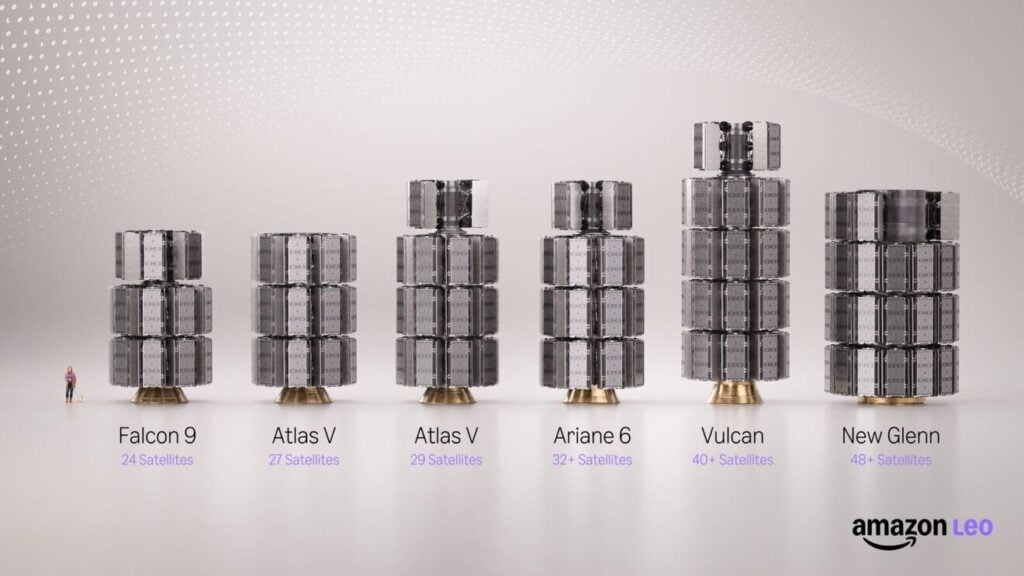
In a July 2 mission update, Amazon said United Launch Alliance’s Atlas V rocket lifted off from Cape Canaveral Space Force Station in Florida after midnight, carrying 29 satellites for its low Earth orbit broadband network.
Leo fleet nears service-ready scale
The mission brought Amazon Leo’s deployed fleet to 396 satellites, following 14 launches tied to the program. Amazon said its mission operations team in Redmond, Washington, made initial contact with all satellites and started health checks after deployment.
The satellites were released at about 289 miles above Earth and will be raised to their assigned operating altitude of roughly 392 miles before entering service. Amazon has said the network is designed to bring high-speed internet to customers in areas where traditional connectivity remains limited or unreliable.
The latest launch also marked the end of Amazon’s Atlas V phase. Across eight missions, the rocket deployed 224 Leo satellites, giving Amazon a larger foundation as it prepares to begin service later this year.
Amazon turns to heavier launches
Amazon’s next step is to shift more of the deployment campaign to ULA’s Vulcan rocket, which is expected to carry larger satellite batches and help the company expand coverage more quickly.
Melissa Wuerl, director of launch systems for Amazon Leo, said the company already has hundreds of flight-ready satellites at Cape Canaveral, supported by a vertical integration facility built for future Vulcan missions.
Starlink challenge starts to take shape
The transition comes as Amazon works to turn years of satellite development into a live broadband business, entering a market where SpaceX’s Starlink remains the clear leader with a much larger constellation and an established customer base across consumer, enterprise, aviation, maritime and government sectors.
Amazon Leo is still early in its rollout, but the latest launch gives the company a stronger base for its first commercial services. The near-term test will be whether Amazon can move from steady launches to dependable coverage in its initial markets.
For Amazon, Leo could open a new business line that reaches beyond home broadband, tying satellite internet to customers in remote areas, aviation, maritime, government and enterprise markets.
For users, it could add another option where fiber, cable or mobile networks are weak, while giving companies a backup connection for operations far from traditional infrastructure.
The near-term impact, however, will depend on coverage, capacity and launch pace, with Starlink still far ahead in scale.
AMZN rises 2.1 percent before pulling back from session high
Amazon shares opened at $241.70 on July 2 and climbed as high as $246.68, a roughly 2.1 percent intraday jump, before easing back to about $244.
The stock held above its early low near $240.90, suggesting buyers remained active despite the pullback from the session peak.
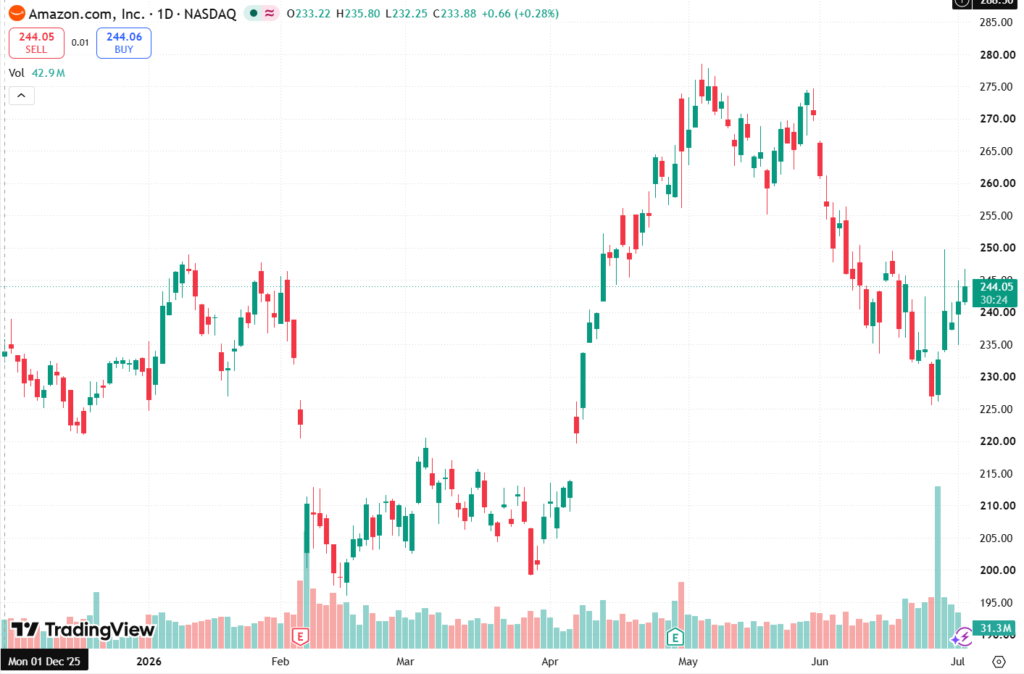
The move extends a short-term rebound from late June levels, but momentum looks mixed rather than bullish, with AMZN still below recent highs and traders watching whether it can reclaim the $245–$247 area.