

In the first week of May 2026, Binance saw major withdrawals of Uniswap’s UNI token. On May 8, the largest transaction among the top 10 outflows hit a high of 13,360 units, recoding the highest level, by far, since November 2025.
UNI tokens leave Binance in droves
According to analysts, the high withdrawal of UNI tokens from Binance indicates strong institutional activity. It suggests that investors with huge UNI holdings are choosing to move the digital asset off-exchange.
On May 10, the daily outflow pulled back slightly, to 9,986 UNI tokens. In the meantime, the 7-day moving average increased to 8,639 UNI – the highest level since July 2025.
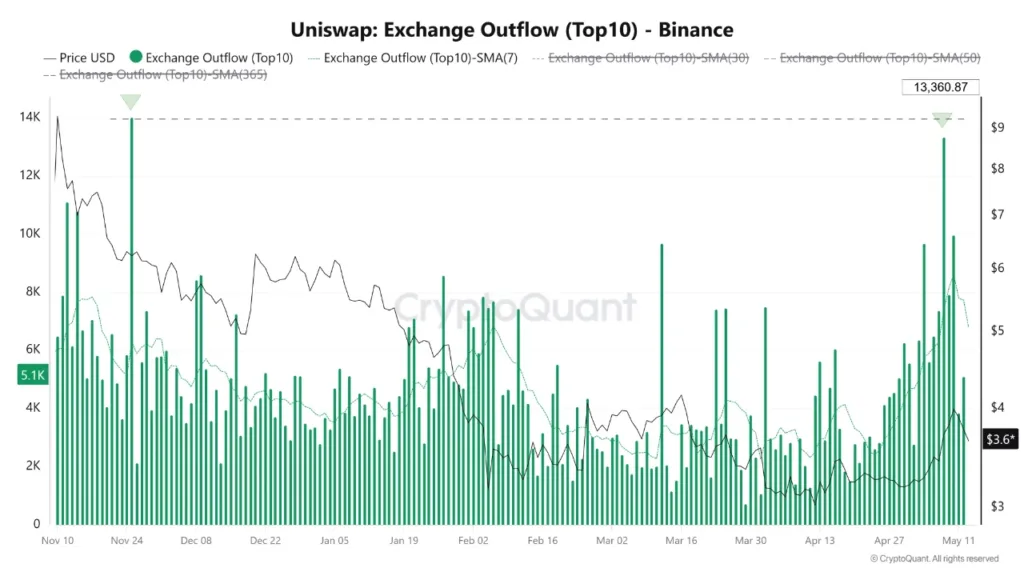
This synchronization among the various metrics suggests that it’s an intentional and genuine movement of UNI tokens rather than random fluctuations, giving further evidence that it may very well be institutional repositioning.
There are two major implications of UNI token outflows. First, it shows that investors are getting ready for long-term holding and reducing trading appetite. Second, it shows that they are also ready for major sell-offs.
From traders’ perspective, the UNI token outflows are important too, as huge outflows typically tend to precede substantial price movements. Market participants are likely to monitor these trends, and see whether the elevated outflow movements sustain or fizzle out.
If the outflows hold up, it could signal a strong belief among the stakeholders, supporting upside movement. Conversely, if the outflows lose momentum, it could signal a sentiment change from bullish to bearish.
Uniswap API adds payment flow feature
On the protocol level, Uniswap continues to build. The leading decentralized exchange on the Ethereum blockchain by trading volume, Uniswap recently stated that its application programming interface (API) now supports payment flows.
Payment flows let developers turn Uniswap swaps into a direct payment rail, where the output token is automatically sent to a chosen recipient address instead of the swapper.
This makes it easier to build checkout systems, merchant payments, and cross-asset settlement without extra transfer steps or manual wallet handling.