


When the crypto market was struggling over the past few months with uncertainty, doubt, and fear, stablecoins have been the preferred choice for many institutional investors and traders. In addition, investors have also resorted to getting involved in Ethereum staking activity during the recent past.
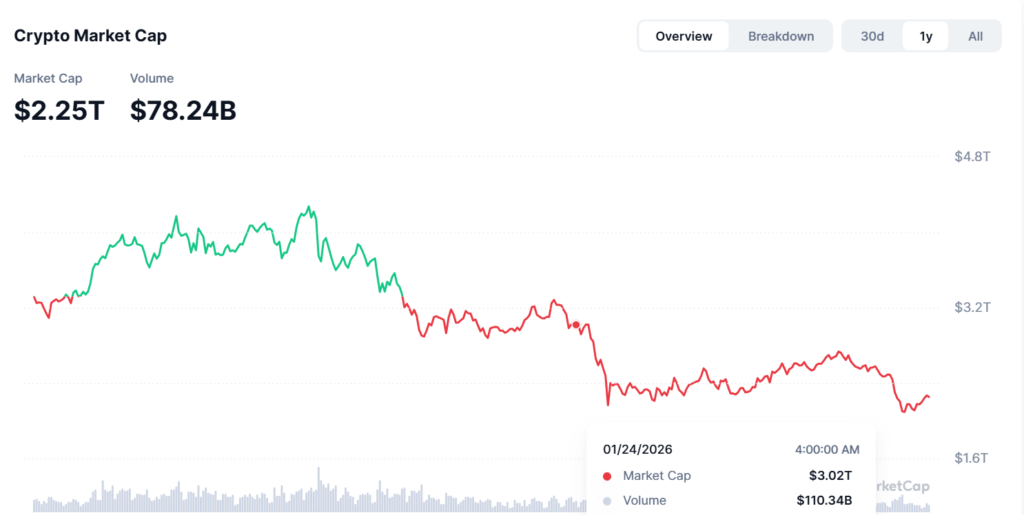
Total crypto market cap recovers
As the crypto market cap slowly but surely heals from its $2.1 trillion support level, stablecoins have been dominating the past few months when there was geopolitical tension in the Middle East.
Traders resort to stablecoin as safe haven during market uncertainty
During periods of geopolitical uncertainty and market-wide FUD, traders often rotate into stablecoins because they offer a safe haven without requiring an exit from the crypto ecosystem. Unlike volatile assets such as Bitcoin and altcoins, stablecoins maintain a relatively fixed value, usually pegged to the U.S. dollar.
This allows investors to preserve capital while avoiding the sharp price swings that often accompany risk-off events. Stablecoins also provide liquidity and flexibility, enabling traders to quickly re-enter the market once conditions improve.
As tensions in the Middle East escalated and uncertainty weighed on investor sentiment, many market participants chose to park funds in stablecoins, causing their market share to rise while demand for riskier crypto assets declined.
Stablecoin growth doubles while supply grew by just 10%
According to CryptoRank, a crypto research and analytical platform, the stablecoin dominance nearly doubled since crypto’s September 2025 peak, but supply grew by just 10.6%. The stablecoin dominance is a parameter that measures the percentage of stablecoin growth over the total market cap.
When total crypto market cap declined from $4.21T to $2.10T (-50%), stablecoin supply rose modestly from $286B to $316B (+10.6%).
A third of ETH supply is staked
And now that the market is healing after the US-Iran conflict has reached a de-escalation, there is a new trend of investors staking Ethereum. An analyst who goes by the pseudonym Lucky stated that one in three ETH coins are locked in the protocol.
Another analyst with the stage name Leon Waidmann mentioned that the entry queue for staking ETH and becoming validators has hit 3 million ETH, while the exit queue is basically zero.
Traders and investors continue to stake ETH during market downturns because staking is often viewed as a long-term conviction play rather than a short-term trading strategy.
When investors stake ETH, they earn yield from securing the network, allowing them to accumulate more ETH while waiting for the market to recover. If they believe Ethereum’s price will be significantly higher in the future, temporary market weakness may actually encourage them to lock up their holdings instead of selling.
A large staking queue alongside a near-zero exit queue also suggests that investors are not rushing to liquidate their ETH despite the downturn. Instead, they are willing to sacrifice liquidity in exchange for staking rewards, indicating confidence in Ethereum’s long-term prospects.
Additionally, every ETH staked is effectively removed from the liquid circulating supply, reducing potential selling pressure. This dynamic can be viewed as bullish because it shows holders are choosing to earn yield and hold through uncertainty rather than exit the market.


