

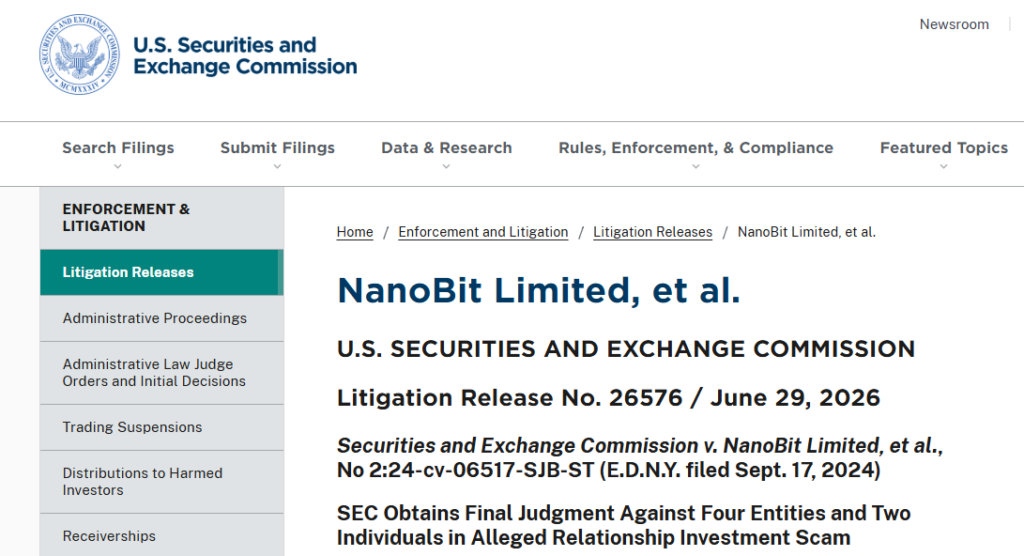
U.S. District Court for the Eastern District of New York entered a final judgment against four entities and two individuals in the Securities and Exchange Commission (SEC)’s case against NanoBit (a fake crypto trading platform). The scammers are now ordered to pay more than $5 million in restitution, prejudgment interest, and other penalties.
This whole scheme (running from September 2023 to June 2024) was basically about fraudsters impersonating financial pros in WhatsApp groups.
The anatomy of a relationship scam
Back on September 17, 2024, the SEC launched a lawsuit against a group of people who were pulling a fast one on investors through WhatsApp groups by pretending to be big-shot financial pros. They cooked up this whole story in which investors were prompted to put money into the NanoBit trading platform, but in reality, nothing was ever actually happening on that so-called platform. This whole ruse went down between September 2023 and June 2024.
At that point, the NanoBit platform tried to look legit by claiming its affiliate, NanobitUS Securities, was registered with the SEC, which was a total lie. The people running the scam pushed investors to buy into fake initial coin offerings (ICOs) with promises of big payouts.
But, the whole thing was that the NanoBit trading platform wasn’t actually processing any trades at all. Instead of helping people trade, the scammers just siphoned off over $2 million in cash from investors and moved massive chunks of the loot (hundreds of thousands of dollars in crypto) over to bank accounts in Hong Kong.
The judgment: Over $5 million in penalties
The final judgment permanently enjoins the defendants from violating securities laws and orders significant financial penalties. NanoBit Limited is ordered to pay $532,649 in disgorgement, $81,957 in prejudgment interest, and a $1,182,251 penalty.
Radiant Horizons and Zhao Deli must each pay $1,182,251 in penalties. Liu is ordered to pay $60,603 in disgorgement, $9,485 in interest, and a $50,000 penalty. Zhao must pay $4,500 in disgorgement, $704 in interest, and a $50,000 penalty.
Basically, this judgment just shows that the SEC is staying on top of these crypto scams that use social trust as a weapon to rip off investors.
The broader crackdown: Why this case matters
The NanoBit judgment is part of a wider SEC offensive against crypto romance and relationship scams. So far, in 2025 alone, the agency filed more than 60 enforcement actions targeting fraudulent crypto investment schemes. Importantly, relationship scams represent one of the fastest-growing categories.
The playbook is always the same: scammers hang out on dating apps, LinkedIn, and WhatsApp to gain your trust for weeks or months, then eventually push a “guaranteed” crypto investment opportunity. The SEC’s Cyber and Emerging Technologies Unit, which helped out with NanoBit, has made stopping these a top priority.
The agency’s warning note explains that “fraudsters may use popular social media platforms and messaging apps to lure investors into scams” and advises people not to trust group chat tips alone.
Basically: the same tech that helps crypto grow is also being used to take advantage of people. As the SEC keeps chasing these bad actors down, the NanoBit ruling acts as a solid warning for anyone else looking to try a similar scam.