

Ethereum gas fees would often just eat up the trade even before the user clicked confirm. This is what most people haven’t figured out about the working of rollups and how they solve this problem. A rollup does this job by bundling all of the batch of transactions you (and hundreds of others) are trying to send and placing them onto another blockchain.
One single compressed summary of these transactions is then submitted back onto the main chain to verify their integrity, which proves it using L1 security while costing only a fraction of that. This innovation single-handedly is the reason why essentially every prominent scaling venture at present calls itself a “rollup.”
The working of the bundling process
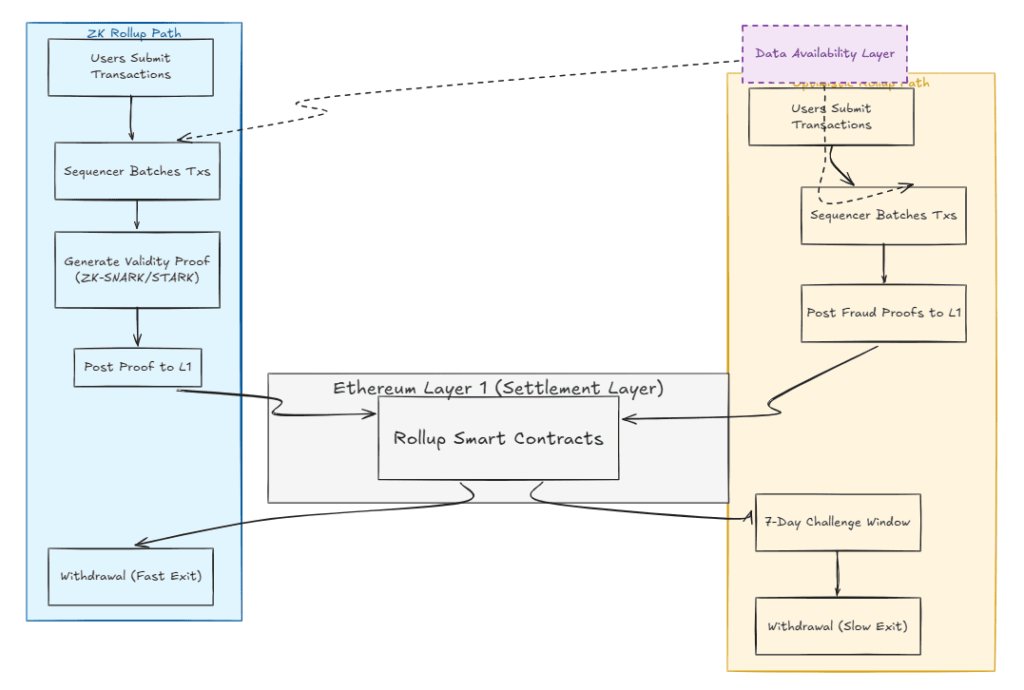
Consider Ethereum a courtroom that works by charging on a minute-by-minute basis. Each transaction wants its own day in court, and that takes up serious capital to do so. Rollups bundle them by the thousands into one batch and send them to court only once; it simply goes back to court in the case if someone disputes the outcome.
For the batching process, all work is carried out by the sequencer. It functions to collect the transaction off-chain, order them, and finally compress the result into a single proof that is posted to the ethereum chain. The confirmation is then provided by the rollup itself to the users. For the final settlement, it takes some time on L1.
Two rollups but the approach is different
There is the split that is of significant importance.
Optimistic rollups assume that each batch is fine and no proof is necessary before submission, which gives them speed and low costs. However, in an attempt to solve the lack of proof, users have a period of seven days in which they can report if there are any discrepancies in the transactions that are confirmed from the rollups’ end. This means that any user withdrawal from the network will need to wait approximately one week. The projects like Arbitrum and Optimism utilize this technique for transaction processing.
The exact opposite is carried out by ZK rollups. They work with proving that each batch is correct before posting it. This method relies on math and not on trust, which then requires no challenge period. The settlement of withdrawals is done in minutes and carries a tradeoff, which is harder engineering.
The comparison between speed and trust
Optimistic rollups operate on the concept of trust and verification. ZK rollups work for the “verify, don’t trust” principle. The first is simple and low cost but the other is fast and final but tough to build.
No side has won yet. Optimistic rollups were first, so as a result, they still hold more capital. ZK rollups have more robust long-term architecture. The majority of big optimistic rollup efforts are currently moving to adopt ZK proofs. So it implies which side is gaining more attention.
The major challenge that needs to be resolved
Rollups made the computation part cheaper. They simply haven’t made the data cheap yet. For every block the user has to submit, its transaction data is somewhere for later verification. This is what makes it the main cost. If that gets fixed, we will again see lower costs. That is the silent game that is going on behind the hype on L2.
A cheaper storage lane, which is built just for the rollup data, is termed “blobs,” which is Ethereum’s own fix. The other projects make use of separate data availability layers and skip ethereum altogether. They are just following different angles, but the goal remains the same. The traffic will be attracted to the side that gets the data costs down.
How it can decide the next cycle
The next real problem to solve is storage cost. Whatever has the lowest cost will produce the lowest cost and fastest rollups and will consequently draw users. That’s what the layer 2 game is really about, not token prices and shilling.
Ethereum fees didn’t ease up from the rollups. They have created two different approaches to scale the network. The method that proves to be more efficient is most likely to shape where users and developers will get involved in the upcoming years.