

Flash loans are the no-collateral, no-credit-check crypto loans. The catch here is that the user must borrow and repay in the same transaction, and that only takes seconds. Failure to repay in time means the flash loan never existed.
Why there is no requirement of collateral
Traditional Loans require some kind of asset as collateral. How is the bank supposed to make sure that you do not simply disappear with the borrowed money? A flash loan provides a different solution for this by relying on the blockchain’s inability to split a transaction that is still “in transit.” A transaction does not half finish or simply stop; it either completes in all possible ways or fails entirely with the parties getting back to the start.
So if a user borrows the funds and can’t pay them back by the end of the transaction, the whole transaction cancels itself. It’s like it never happened. The lender gets their money back automatically. The borrower just loses a small transaction fee, called a gas fee, for nothing. This safety trick is called atomicity. One transaction, one outcome: it all happens, or none of it happens.
The working of flash loan
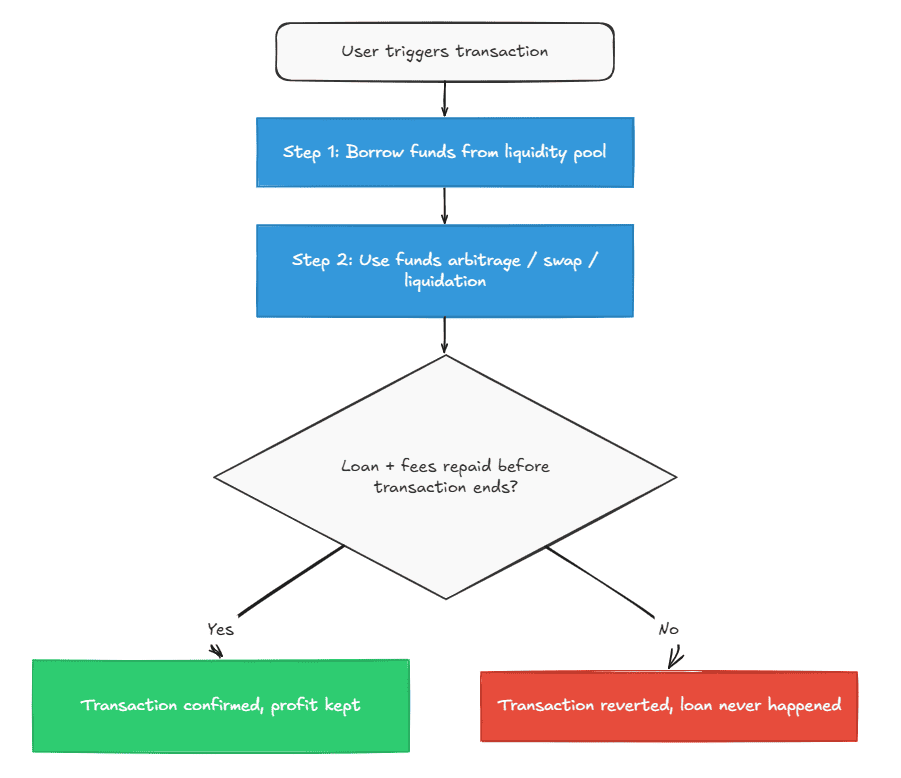
The process of flash loans works with the same three steps that take place in the single transaction. At the first step, the smart contract borrows the capital from the lending pool and makes use of that capital on an immediate basis. This is often to make the trades across multiple platforms before the repayment of that loan, combining the fees before the transaction finalization.
In the case of the failure of repayment, the reversal for the transaction takes place and there is no loss for the lender. This happens because smart contracts execute all three processes within seconds of their execution; that’s why Flash Loans can typically be found in the form of a DeFi instrument on different financial platforms, namely, Uniswap, dYdX, and Aave, and not on standard exchanges.
Why do people make the use of flash loans
The flash loan concept can do more than just lend people funds. A trader might, for example, take out a flash loan to exploit an arbitrage strategy, buying a token on one platform cheaply, selling it for a profit on another platform and repaying the flash loan. They might also use a flash loan to substitute the collateral on a loan without actually paying that loan off.
Traders can also use flash loans to liquidate risky loans and earn a reward. The main appeal is that users can access large amounts of capital without using their own money. If the strategy fails, the transaction reverses and the trader generally loses only the gas fee.
The flash loan attacks is a risk here
Flash loans seem riskless for the use as intended but the main reason that makes them safe also makes them extremely risky for any attack. Anyone can borrow a tremendous amount of funds for a few seconds and use it for the attack at other defi platforms.
How typical exploits work are usually things like this: an attacker will take out a big loan, borrow it, attack a price feed to break something, exploit a bug on some other protocol, withdraw all the profit, pay back the loan, and have whatever’s left over to pocket. In the worst case, the transaction simply reverts back, which is no risk.
The biggest exploit happened in March 2023 over Euler Finance. A bug was exploited in one of the functions of the protocol, and the hackers utilized $30 million borrowed through a flash loan on Aave to then steal $200 million in stablecoins and other tokens. However, mysteriously, they returned nearly everything a few days later with a note of apology transmitted on-chain.