

As of Wednesday, the total amount of exchanges has reduced to 15.07 million Ethereum from around 16.75 million in early Jan. Five months’ worth of withdrawals that, on any normal setup, would be taken as a bullish signal for a shortage of supply.
Price is currently trading at $1,759, down 2.95 percent on the session. The high/low range of the relative asset was $1,712-$1,819 and the volume was 7.34 million. Short-term MAs are in strong opposition to the medium and long-term ones: SMA7 is currently at $1,959, and SMA200 is at $2,478. The gap that exists between current price action and these higher MAs isn’t a spread of value that can be closed in the time period of one week.
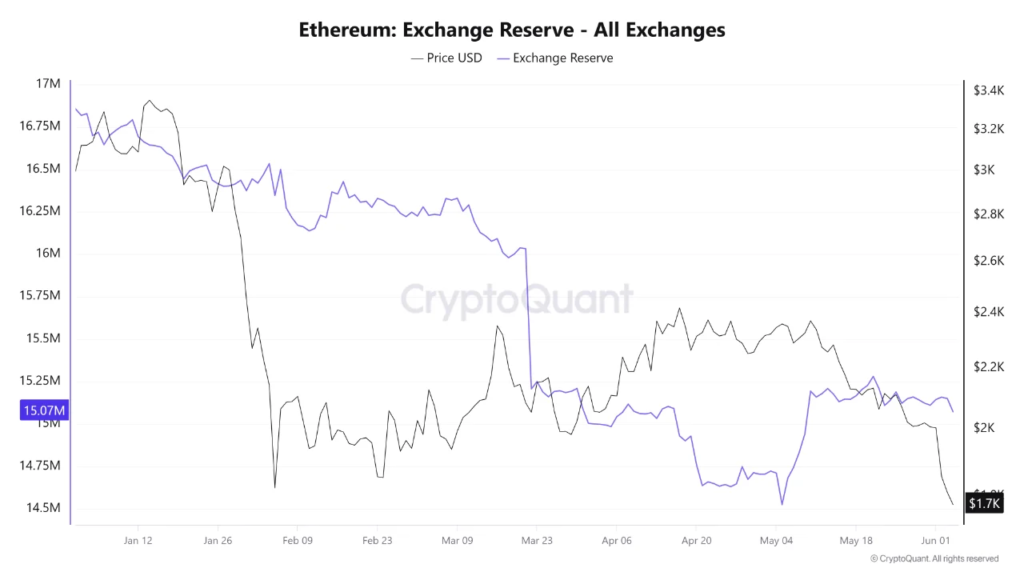
There is a narrative shown on the CryptoQuant chart that the overall reserve figure does not show for a period from late January until mid-March, when price range-traded and bounced to the price level of $2,400 after a dip. Following that the reserves dropped considerably.
That’s the window where the market participants observe a very confident-looking withdrawal. Let’s say an ETH wallet withdraws coins to put into cold storage ahead of moving them. Later on, the price of the asset returned back and went under the price of $2,000 toward the end of May and thereafter it dropped further. Reserves never paused their downward trend during that phase. The wallets that dumped off coins originating from CEXs never experienced a pause when the selling started but kept on withdrawals as if to say they’re fine with accepting the loss, or the sell pressure comes from an entirely separate group, and they never had anything to do with the centralized exchanges.
The second interpretation is on the more concerning side. It means that spot exchanges weren’t the source of pressure. Perp placement, flows from OTC, and large holders being released via non-custodial channels. All these things wouldn’t impact the exchange reserve metric and the price could go through a drawdown.
The signals from momentum indicators
MACD is -89.12 while having the histogram displaying the figure of -20.84 and expanding. Momentum is not slowing at this time. RSI (7) on Wednesday was standing at 9.43. RSI(14) stood at 19.91, which is under the oversold space as well. Both imply that the market sellers are drained out and that buyers are not accumulating. Mean reversion bounce comes off these levels but this will not mean the downtrend is about to end.
What does the chart depict
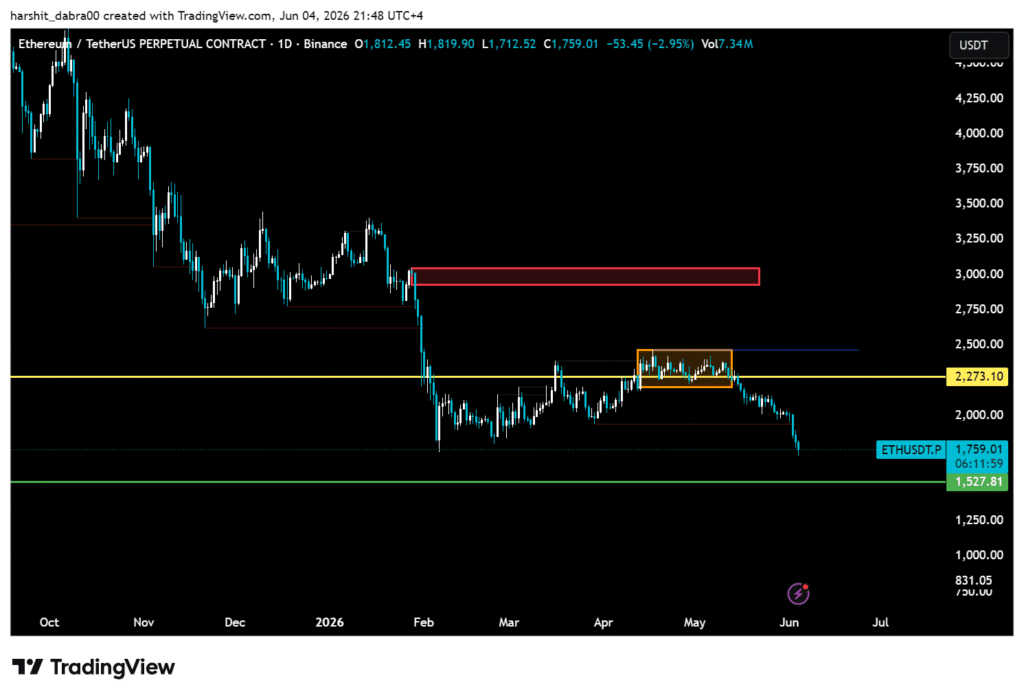
The chart pretty much reflects the rough side of the asset. ETH went through a downturn from its $3000 highs in Feb. Between the time period of March and April, the buyers tried to hold over the level of $2273, which is marked as the yellow line in the chart. This lasted about six weeks, but thereafter it dipped sharply in late May and is now acting as resistance instead of providing support to the asset. Wednesday’s session low was unable to get back over the $1824. Under the current price of $1759, the next real base would be around $1527 as it was the level that was the driver of the whole uptrend.
The midpoint of the recent swing on the Fibonacci levels is currently standing at $2,097. ETH has to recover from this point before anyone can legitimately call this trend shifting, as they are far from it at the moment.
One last thing worth noting on the reserve data to note is that as exchange reserves dipped, beginning in March and lasting into early April, ETH climbed from $1850 all the way to $2400. The rally faded away, and since reserves actually edged up through May (which would indicate that some participants put coins onto exchanges during the range-bound phase), it shows selling, and some people call it accumulation, which should not be the case.