

Bitcoin has seen a drop of around 18 percent from the late May high of nearly $74,000 to $60,722 as of Monday, June 29. It wasn’t a messy break; there was not one day where the entire structure collapsed, but it was more of an unusually slow move that opened below the current price for the week and the day without any sort of panic-selling flush beneath either level.
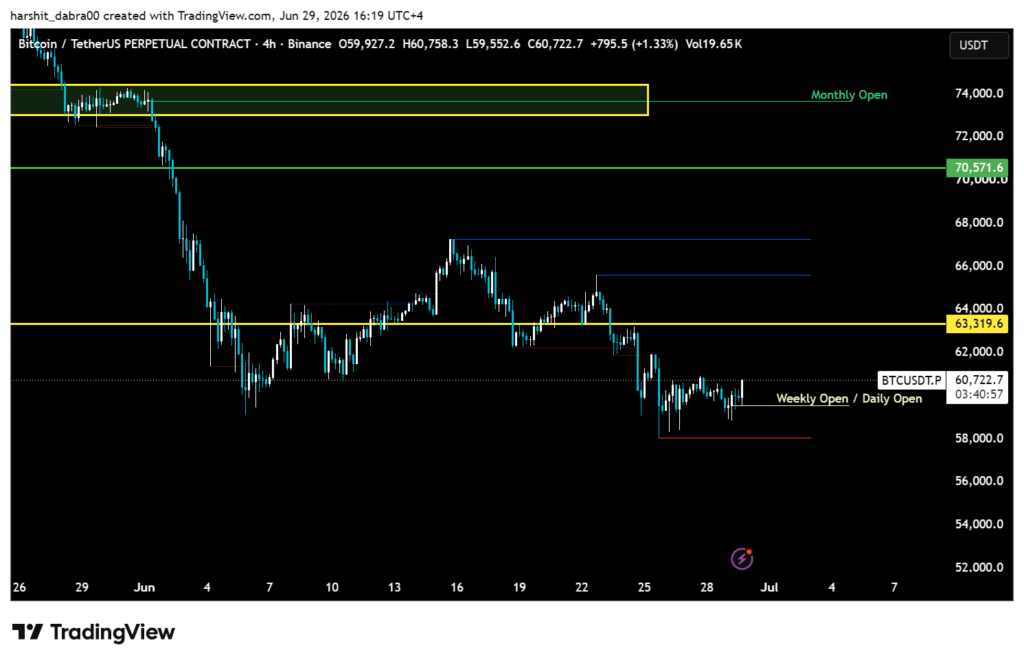
The corresponding confluence is sitting around the zone of $60,500 to $60,700. The asset’s price identified it and has bounced intraday to the price level of $60,722. It has continued to be in the compressing phase for the past few sessions as we move into July.
At the time of writing, with the reading of RSI14 standing at 30.70, and RSI7 of 25.69, we certainly do see that the market is technically oversold in the short run. Although “oversold” is a condition, it does not mean a buy signal. Markets can stay oversold, often times for weeks, while the midterm structure remains in distribution. The real thing to pay attention to here is that it is short-term exhaustion taking place with either a liquidity vacuum or really large bids present.
The important pivot level is currently at $59,614 and in the case the asset closes under it, it may then create additional pressure to test the $58,075 area and this is where the fibonacci base is located.
MACD histogram has shifted to negative just as Saylor monetizes the stack
The MACD setup has now managed to fill in some background on the read. MACD is at $ -2,355.87 and that is clearly under the zero line. Signal is standing at $ -2,307.96 which is marginally less negative than the MACD.
The figure of the histogram is at $-47.91$ and is standing as one of the most important figures, as it turned out. The negative momentum remained only fractional, so the bearish momentum variation actually compressed, although it didn’t completely turn bullish. The market sellers still hold the control but the thing they are not able to control is the speed.
And in the interim, Michael Saylor’s Strategy has recently made the announcement for a Bitcoin Monetization Program. This essentially provides the option for Strategy to sell Bitcoin (BTC) to finance operations. This similar trend was done back in the year 2022 where Do Kwon used UST to accumulate and then later, they dumped BTC to save UST.
But on its own, such a single bullet point alone would be sufficient to justify a thesis reset. Rather, the full picture that Strategy has put in writing goes further on this: The Digital Credit Capital Framework sets authorizations of Bitcoin sales up to $1.25 billion and a 12 percent dividend rate for STRC. They also introduced $1 billion in buybacks of both its preferred securities and MSTR stock. This is not a pivot, and it is an actualization monetization framework anchored in a previously perpetual-in-nature Bitcoin treasury.
Strategy has been in the accumulation phase for years now. Following this strategy that allows for the sale of 9-figure BTC, a carried interest that is tied to said treasury, as well as running buybacks, is not a company planning to grow its way into the price appreciation of assets that are owned by it.
As traders have raised their exposure year after year, at least slightly based on the premise that Saylor’s stack was “permanently frozen” in place. At this point in time, this assumption has already been formally rewritten but with more legal and capital structure documentation attached to it.
Is a relief rally possible?
The part for the short-term bounce is still building for this largest cryptocurrency as the asset nears a key support zone. Considering the part of RSI, RSI7 is at 25.69 and RSI21 is standing at 33.04 and that depicts that the selling pressure has been pushing the market to the oversold zone. The point at which the weekly and daily open align ($60.5k to $60.7k) is now acting as a short-term point of interest for the bulls. If that zone holds strong at $59,614 then there is a high possibility for the upside targets of $63,300.