

Although Bitcoin (BTC) is down about 8 percent on a year-to-date (YTD) basis, exchange data shows that long-term holders are starting to scale back on selling. The Coin Days Destroyed (CDD) metric shows that BTC long-term holders are becoming less active in the market.
Bitcoin CDD falls to 5-month low
The cryptocurrency market hasn’t had the most spectacular start to 2026, as the total crypto market cap is currently hovering around $2.7T, much lower than the highs it was trading close to back in October 2025, around $4.2T.
The impact of the tumbling total crypto market cap has impacted all digital assets, including BTC. Fresh exchange data shows that during the second-half of 2025, Bitcoin’s long-term holders displayed a high level of activity in the market.
However, with the CDD parameter now falling to a 5-month low, things are looking a lot more positive about BTC.
For the uninitiated, CDD is a Bitcoin metric that measures how long coins were held before being moved, by multiplying the number of BTC moved by the number of days they were previously inactive.
Higher CDD signals older coins being spent – mostly linked to long-term holders selling or redistributing. On the other hand, a lower CDD suggests reduced long-term holder activity.
The following chart shows CDD as a heatmap – making it easier to identify the periods during which Bitcoin long-term holder activity become significantly elevated.
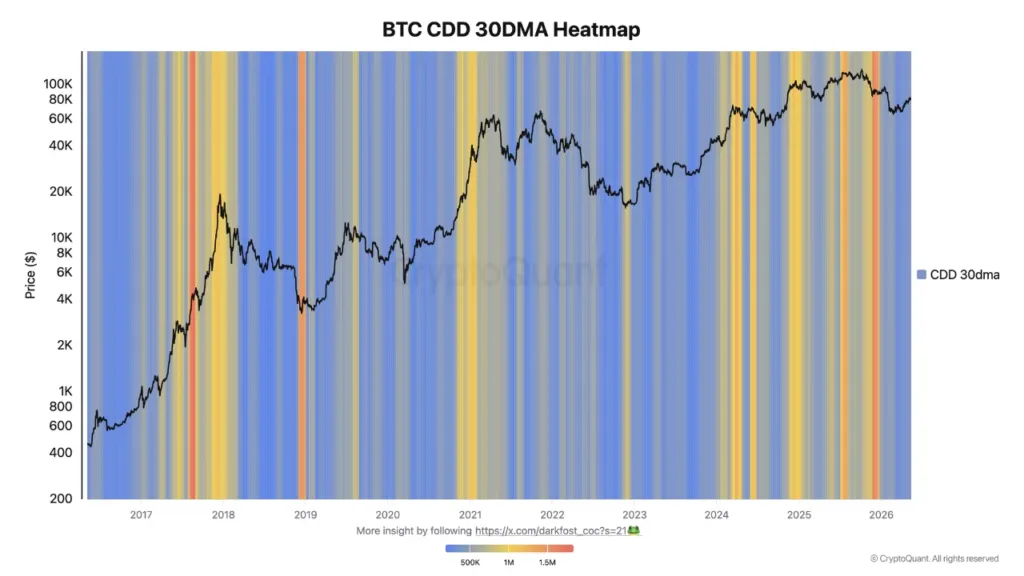
As can be seen in the heatmap, at the moment, the Bitcoin market is experiencing a CDD cooldown phase. This corresponds to a relatively low level of long-term holder activity, resulting in a much lower selling pressure from these holders.
Analysts’ opinion split on BTC trajectory
Analysts’ opinion on Bitcoin’s trajectory from its current state is divided. Earlier this week on Monday, an analyst remarked that BTC is flashing a severe correction risk according to a Nobel-inspired price model.
Similarly, macro forces continue to weigh on BTC. The higher than expected U.S. CPI print on Tuesday led to liquidations worth more than $1.2B in BTC futures contracts, most of them being long positions.
That said, some analysts are leaning bullish as well. On Thursday, an ETF-flow price model suggested that BTC’s current price is about 11 percent below its fair price.