

Cardano is moving closer to its V11 “van Rossem” hard fork, with testnets already upgraded and several key readiness markers now in place.
The upgrade is expected to bring cheaper Plutus smart contracts, new built-in functions and cryptography designed to support zero-knowledge tools.
In a Friday post on X, Cardanians said Preview and Preprod testnets have already undergone the hard fork. The account also said 88 percent of blocks minted over the past seven days were produced on V11, while 80 percent of exchanges by liquidity were ready, including Binance and Coinbase.
Cardano upgrade waits for final governance approval
The V11 hard fork is now close to mainnet execution, but it has not fully cleared the governance process. Cardanians said the mainnet hard fork governance action received enough votes from Stake Pool Operators and Delegated Representatives. The post added that it is now “pending only CC approval.”
That final step refers to approval from the Constitutional Committee. Cardano’s own update said the van Rossem hard fork process depends on on-chain governance bodies, including DReps, SPOs and the Constitutional Committee. The network had already completed testing on Preview and Preprod before moving toward mainnet ratification.
The Cardano update said the process includes two governance actions. One was a Plutus Cost Model parameter update, enacted on June 18. The other was the hard fork initiation action, submitted on June 16.
The upgrade is named after Max van Rossem, who contributed to the Cardano community and its governance structure. It is an intra-era hard fork, meaning Cardano can add new features without moving into a new blockchain era.
V11 targets cheaper Plutus contracts
The V11 upgrade is expected to reduce costs for Plutus smart contracts. Plutus is Cardano’s smart contract platform, used by developers to build decentralized applications on the network.
Lower smart contract costs can help developers run applications with less friction. It may also help projects that rely on frequent on-chain activity, including DeFi tools, wallets and other blockchain services.
The upgrade will also add new built-in functions. These tools can give developers more direct ways to build and verify logic inside Cardano applications. They are part of Cardano’s slow and structured upgrade path.
Cardanians also said V11 includes ZK-ready cryptography. Zero-knowledge tools can help users prove information without revealing the full data behind it. That area remains active across the wider crypto sector as developers test privacy, scaling and verification use cases.
Binance and Coinbase signal readiness
Exchange readiness is one of the main items watched before a hard fork. Cardanians said 80 percent of exchanges by liquidity are ready for V11, including Binance and Coinbase.
This matters because exchanges need to prepare their systems before a network upgrade. If they are not ready, deposits and withdrawals can face delays during the transition.
The update also said 88 percent of blocks minted over the past seven days came from V11 node software. That figure points to high participation from upgraded infrastructure across the staking network.
Still, the final mainnet move depends on governance approval. The upgrade cannot fully move ahead until the remaining governance step clears. That makes the Constitutional Committee’s role central in the final phase.
ADA price rises as upgrade nears
ADA also moved higher as the hard fork approached. According to The Coin Headlines market data, Cardano (ADA) traded at $0.18, up 15 percent in 24 hours. In addition, Cardano’s market cap stood at $6.79 billion, while its 24-hour trading volume reached $661.72 million.
Meanwhile, ADA rose 23.22 percent over seven days, though it remained down 69.29 percent over one year. That shows the token has recovered in the short term but remains far below earlier levels.
Cardano had started to rebuild after a steep decline, while on-chain activity and discussion around the network had picked up. Cardano had recorded 29,025 daily active addresses and rising social activity, as previously reported.
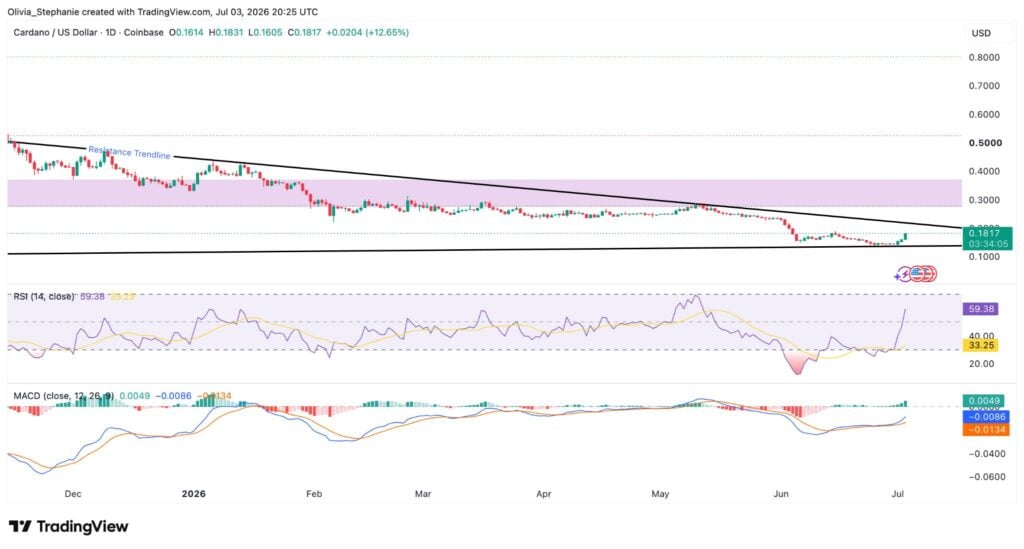
From a chart view, ADA is still trading inside a broader downtrend. The token has bounced from lower support, while RSI and MACD have improved in the short term.
A move above the $0.18 to $0.20 area would help confirm stronger momentum. Failure near that zone could keep ADA below broader resistance near $0.30 to $0.35.
Finally, Cardano’s upgrade story and ADA’s price recovery are moving together. The hard fork has cleared several technical and exchange-readiness steps, but the network still needs final governance approval before V11 can move to mainnet.