




Today, crypto is not living on one chain. Ethereum, Solana, Arbitrum, BNB chain and other networks like Monad each function as unique and isolated systems. If an individual wants to hold a token on one chain and want to make use of it on the other, this is where the bridges comes in.
What does a Crypto Bridge actually do?
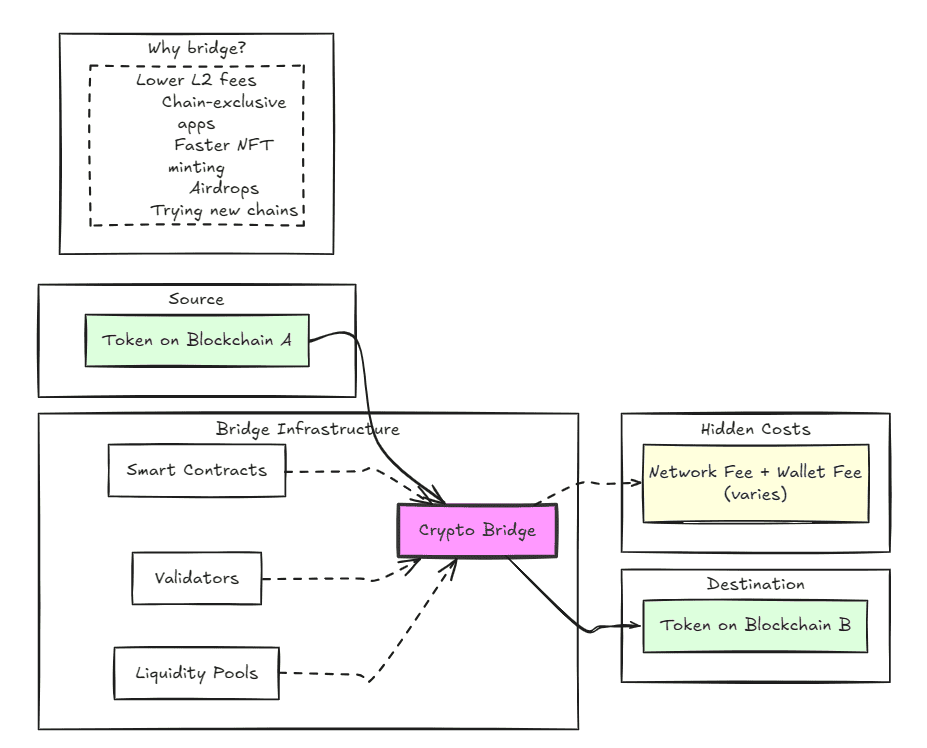
When you think about what it means for the future of crypto to send an asset from Blockchain A to Blockchain B, this is where you will make the use of crypto bridges. It makes the use of smart contracts, validators, or liquidity pools to make sure that when an individual sends a token on Chain A, you receive the equivalent on Chain B.
The reason people make use of bridges is simple: lower fees on a layer 2. Needing access to a DeFi app that solely works on one specific chain, searching for more rapid NFT minting, trying to find airdrops in several different ecosystems, or even just wanting to try out a new chain like Monad rather than attempting to start over from a blank slate.
The one important thing that the beginners usually miss is the price tag that is linked to the bridge transaction and not just the network fee. Usually there are some wallets that silently add their fee on top of the protocol fee. Following this, the two individuals who are making use of the same bridge can pay different total costs and that will depend on which wallet they use for executing the transfer.
The three ways bridges makes the money move
- Lock and mint: In this method, the original tokens get locked in a smart contract on the source chain itself. On the destination chain a wrapped version of that gets minted. This method is the most widely used.
- Burn and mint: Following this way, instead of locking the original tokens like the lock and mint method, the bridge destroys them and it involves minting the fresh equivalent on the new chain. This method is used for clear accounting by some layer 2 as well.
- Liquidity-based bridging: This method is one of the fastest methods among all of these. The bridge already keeps token pools sitting on both chains, so every time the user makes the deposit on one side, one will instantly receive the corresponding token from the pool on the other side, and there will be no involvement of locking, minting, and waiting.
How do you select the right bridge
There are a couple of quick checks before the use makes the push of anything across chains like Is the bridge audited with a history of success? Does it support both of the user’s source and destination chains? Is there enough liquidity to support a seamless passage? Will the user be getting a native token or a wrapped token, and that changes how one will be able to deal with it on arrival?
One beneficial habit here will be to send a small test amount and then confirm that it landed correctly. If the transfer is successful, the user can send the rest.
The common problems with bridging
Generally most bridging errors are minor and solvable. If the tokens you’re anticipating just don’t appear, then often they are either on the wrong network on your wallet, or simply require a manually method to be added in. Receiving a wrapped token instead of a native one when using a lock and mint bridge is intended behavior, rather than a generic mistake. Transactions that aren’t being finalized can usually be resolved through the redeem feature on the bridge. One of the few actions you’ll need to be extremely cautious of is making the transfer of funds to the wrong network.


