

Nasdaq-listed Bitcoin treasury company Nakamoto has launched an actively managed Bitcoin derivatives program with Bitwise Asset Management and Kraken Institutional Services. The program aims to generate recurring income from Bitcoin volatility while hedging part of the company’s downside exposure.
Nakamoto said on Friday that the program has been active since the first quarter of 2026. It uses a defined portion of the company’s Bitcoin holdings as collateral for options and other Bitcoin-linked derivatives.
According to the company, part of its Bitcoin is held in Kraken’s qualified custody solution. Bitwise manages the derivatives strategy through a separately managed account. Nakamoto said the program supports its wider Bitcoin treasury plan rather than replacing its spot Bitcoin holdings.
Nakamoto starts Bitcoin derivatives program
Nakamoto announced the program is designed to work alongside its core Bitcoin asset management strategy. The company wants to earn income from Bitcoin’s options market while protecting part of its balance sheet from price declines.
The program uses a portfolio of listed and over-the-counter Bitcoin-linked derivatives. Nakamoto said the strategy is built around two parts. One part targets income, while the other part focuses on downside protection.
The income part uses covered calls and call spreads. Through this approach, the company writes options against a defined portion of its Bitcoin holdings. The goal is to collect premium income from Bitcoin’s implied volatility.
Additionally, the hedging part uses protective puts and put spreads. These contracts are designed to reduce the company’s mark-to-market exposure if Bitcoin prices fall over set periods. Nakamoto said some hedging costs may be partly funded by income from the options income strategy.
Bitwise manages strategy as Kraken holds collateral
Under the arrangement, Bitwise manages the derivatives strategy through a separately managed account. Nakamoto said the structure allows the company to run the program under a single investment mandate.
That mandate covers risk controls, allowed instruments, venues, counterparties, custody rules and margin requirements. It also sets limits on the maximum notional exposure of the program as a share of Nakamoto’s total Bitcoin holdings.
Meanwhile, Kraken Institutional Services provides qualified custody for the Bitcoin used as collateral. Nakamoto noted that the Bitcoin held as collateral remains owned by the company and stays part of its publicly reported Bitcoin holdings.
Protective positions bought through the program are held in addition to the company’s spot Bitcoin. Nakamoto said this means the company is not replacing its Bitcoin holdings with derivatives, but adding a risk management layer around part of them.
Premiums under the program may be received in Bitcoin or U.S. dollars. That depends on the instrument, venue and counterparty used. The premiums may fund hedging costs, support Bitcoin purchases or cover general corporate needs.
Company seeks income from Bitcoin volatility
Tyler Evans, chief investment officer of Nakamoto and UTXO Management, stated that the program is built around Bitcoin’s options market. The company sees an opportunity to earn income from volatility in a structured way.
“Bitcoin’s implied volatility is one of the most persistently mispriced assets in capital markets,” Evans stated.
He added that the company is working with Bitwise and Kraken to build “a disciplined framework” to capture that premium and create long-term value for shareholders.
Evans also noted that the program is one part of a broader effort to find ways to generate yield on Nakamoto’s Bitcoin holdings. The company said it may use income from the program to support treasury growth, cover operating costs or retain working capital.
The strategy could limit some upside on Bitcoin covered by written calls if the price rises above selected strike prices. Nakamoto said strike selection, position size and contract duration will follow its risk framework.
The results of the program from the first quarter of 2026 will appear in the company’s Form 10-Q for that period. That filing should give investors more details on how the strategy performed during its early phase.
Bitcoin treasury firms face market pressure
Nakamoto’s update comes as Bitcoin treasury companies face pressure from weaker crypto prices. At press time, Bitcoin traded around $77,700 after falling about 38 percent from its October 2025 record high of more than $126,000.
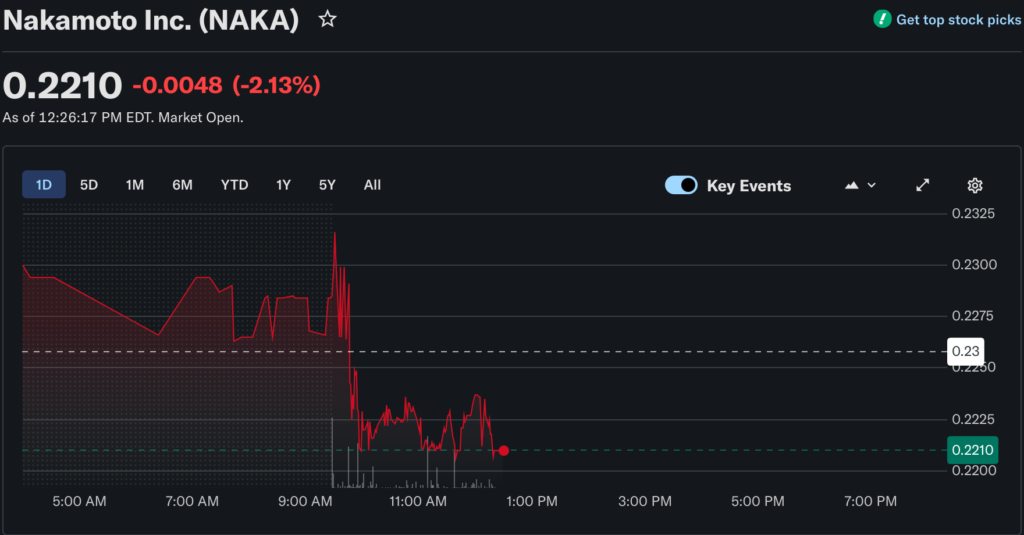
Nakamoto’s share price also came under pressure. The stock traded near $0.22 at the time of writing, down about 2 percent during the session. It was also down about 46 percent for the year, according to Yahoo Finance data.
The company currently holds 5,098 Bitcoin, worth about $395 million based on recent market prices. Bitcointreasuries data ranks Nakamoto as the 20th-largest Bitcoin treasury company.
Nakamoto already disclosed a Bitcoin sale earlier this year. In a March 30 filing with the U.S. Securities and Exchange Commission, the company reported selling about 284 Bitcoin for around $20 million.
That sale implied an average exit price of about $70,422 per Bitcoin. The company had built its Bitcoin position at a weighted average purchase price of about $118,171 per coin, meaning the sale occurred well below its average cost basis.
Other Bitcoin treasury firms have also sold holdings during the downturn. Genius Group liquidated 84 Bitcoin for about $5.7 million in February to repay debt. Empery Digital later said it sold 357.7 Bitcoin at an average price of $66,632, raising about $24.7 million in gross proceeds.
Nakamoto’s derivatives program gives the company another way to manage its Bitcoin treasury without relying only on asset sales. The strategy may help generate premium income during volatile periods, while protective puts may reduce part of the risk tied to further price declines.