

Crypto market rallied on Wednesday with Bitcoin and Ethereum hovering around key levels of potential upward breakout, as an easing in geopolitical upheaval improved risk appetite among investors.
Market sentiment has been lifted by reports that President Donald Trump agreed to extend the ceasefire between Iran and the U.S., thereby giving both parties some additional breathing room to pursue negotiations instead of reverting to violence.
Nevertheless, traders seem reluctant to place bets, attempting to determine the reliability of macroeconomic signals that have been somewhat contradictory during the last few months.
As noted by Dean Chen, an analyst from Bitunix, “It’s not a question of rates or conflict. It’s not even about how we position our money. It’s a much deeper question – which signals should we use as benchmarks for pricing?”
Chen is convinced that yesterday’s visit to Congress by Christopher Waller represents a significant portion of this problem. Christopher Waller argued yesterday that he will “absolutely” reject any efforts to remove the presidents of regional Federal Reserve banks due to their disagreements regarding the issue of interest rates.
“‘What begins as a harsh criticism of a ‘misaligned Fed’ attempts to reinstate an outdated system, but the avoidance of politically explosive issues creates another dimension of complexity. The result is structural. Monetary policy is no longer an entirely economic activity – it becomes increasingly political. Once this shift in regimes is priced in, interest rates lose some of their purity as a discounting device, taking a credibility discount,’” writes Chen.
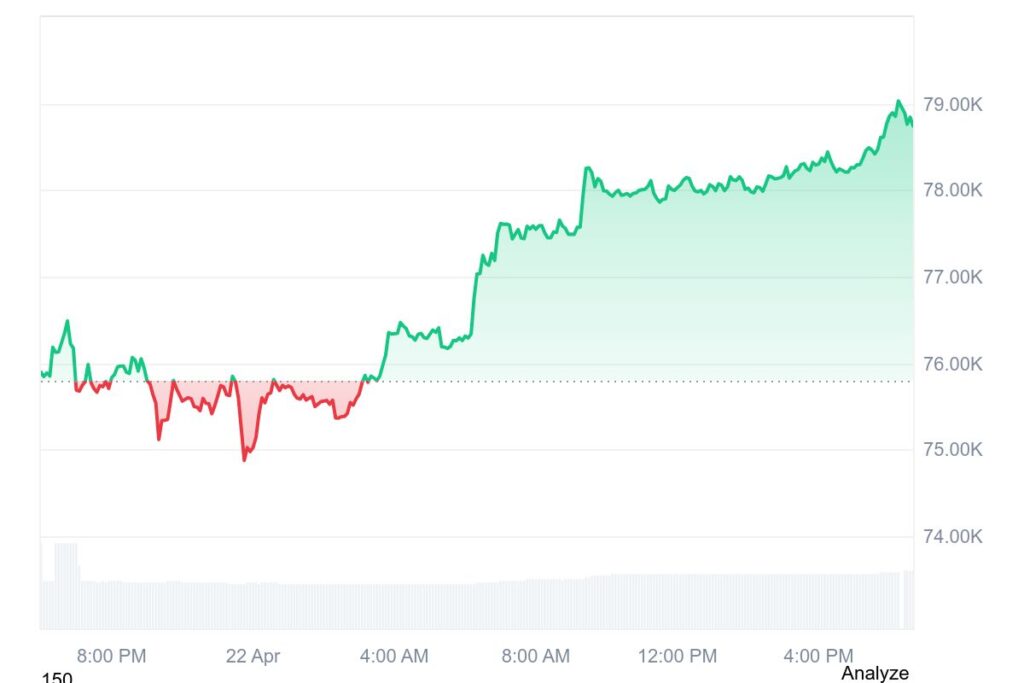
In the midst of all the chaos, the price of Bitcoin rose above the $78,000 mark, which it had been unable to cross last week. Significantly, the BTC price hasn’t crossed this point since January 2026.
The OG-crypto traded at the $$79,072.71, up 4.47 percent in the last 24 hours at the press time.
“Depending on the future is based on the cure of three factors simultaneously. The first is Policy Credibility; that is, the Fed must regain the capability to convey an unambiguous reaction function. The second factor is Energy transmission efficiency; that is, normalization should take place practically and not rhetorically.”
“The third is policy coordination, where other central banks must follow the Fed and resume their predictable pace,”
Wednesday saw some hope for altcoins as well, with Ethereum moving toward the $2,400 level while important support levels remained unbroken. Meanwhile, XRP was well above the $1.45 price mark, with the technical picture indicating improved optimism and a gradual recovery for traders.
As the analysts at Bitunix suggest, the events occurring in the Middle East show clearly that although the risks here are being transformed, they are certainly not going away. A ceasefire may give the impression of stabilization, but economic sanctions such as blockade or restrictions can serve as an instrument to preserve the status quo, moving the war to the economic arena.
The current situation involving Iran is a balance of both escalations and de-escalations, resulting in constant uncertainty at the markets. In this situation, prices for energy resources depend on geopolitics, and consequently, inflation will persist beyond the scope of central banks’ jurisdiction.
Lastly, as Bitunix analysts note, yet another example showing the complexity of the issue is Japan. As a consequence of rising prices and unstable currency, central authorities have been delaying the planned increase in interest rates. Consequently, a notable difference between approaches of the main economic powers emerges, and once central banks act at their own pace, investors will inevitably follow suit.
The largest number of liquidations in the last 24 hours amounted to 108,373 at a total amount of $471.06 million. The biggest liquidation was on Binance – BTCUSDC at a value of $5.50 million.