




Bitcoin took a step back on Monday amid heightened volatility due to geopolitical unrest that rose after the weekend’s peace talks between U.S. and Iran failed to result in an agreement.
Prices across the larger financial markets have suffered as the two weeks of precarious truce between the United States and Iran hangs by a thread after a new set of negotiations held in Pakistan were called off. The Iranian leaders refused to commit to any dialogue due to the continued imposition of a naval blockade by the U.S. in the Strait of Hormuz as well as the capture of Iranian vessel, Touska.
Additionally, concerns over the Federal Reserve’s rate decision and chairperson shuffle have added to the dampening of risk appetite among investors. Nominee Kevin Warsh is set to face a monetary policy road test before the Senate panel.

Iran War and U.S. policy decisions remain main concern
Analysts told Coin Headlines that the market’s core focus has shifted from a single geopolitical conflict to a dual-track dynamic.
Bitunix analyst Dean Chen says, “Uncertain policy trajectory alongside war-driven spillover disruptions are a major concern at present. On one hand, the Federal Reserve remains firmly cautious-Waller and Daly have explicitly tied policy decisions to inflation outcomes and conflict developments, signaling the absence of a clear easing anchor.”
He added, “The White House is attempting to reshape expectations through a framework of balance sheet contraction offset by rate cuts, creating a disconnect between forward guidance and current macro constraints.”
After falling from last week’s highs around $78K, Bitcoin is currently trading near $75K, down over 1.2 percent at the press time. For the time being, investors are not viewing the present action as a return to a downtrend, but rather as a retracement within an uptrend.
Dean Chen highlights that BTC is continuing to oscillate within a defined range.
“The area around $78,000 represents a high-intensity cluster of liquidation and liquidity buildup, while the $72,000-$73,000 range continues to act as a consistent absorption zone, supporting repeated rotation within the range.”
“With macro uncertainty unresolved and policy signals fragmented, BTC remains fundamentally a derivative of risk appetite. Should energy conflict escalate further and reinforce inflation expectations, overhead liquidity is likely to act as a bull trap; conversely, if negotiations yield tangible progress and compress risk premiums, capital may regain the conditions necessary to re-engage higher liquidity zones,” they emphasised.
Bitcoin steady, altcoins volatile
From a technical standpoint, Bitcoin has now broken above the $76,000 resistance level that had capped prices over the past two months, signalling potential for further upside should current momentum persist.
Simon Peters, Crypto Analyst at eToro, commented: “Bitcoin’s breakout above key resistance levels reflects renewed confidence in risk assets, supported by both macro developments and institutional demand. The combination of ETF inflows and short covering has created a strong foundation for price momentum in the near term.”
Sailing in the same boat, most altcoins remained turbulent throughout the day (and night), and their current market prices are remarkably unchanged from their positions 24 hours ago. Ethereum is valued at $2,300, BNB is worth more than $620, and SOL is close to $85.
HYPE and ZEC have lost the most value among larger-cap alts, while CC has increased by almost 3 percent to $0.15.
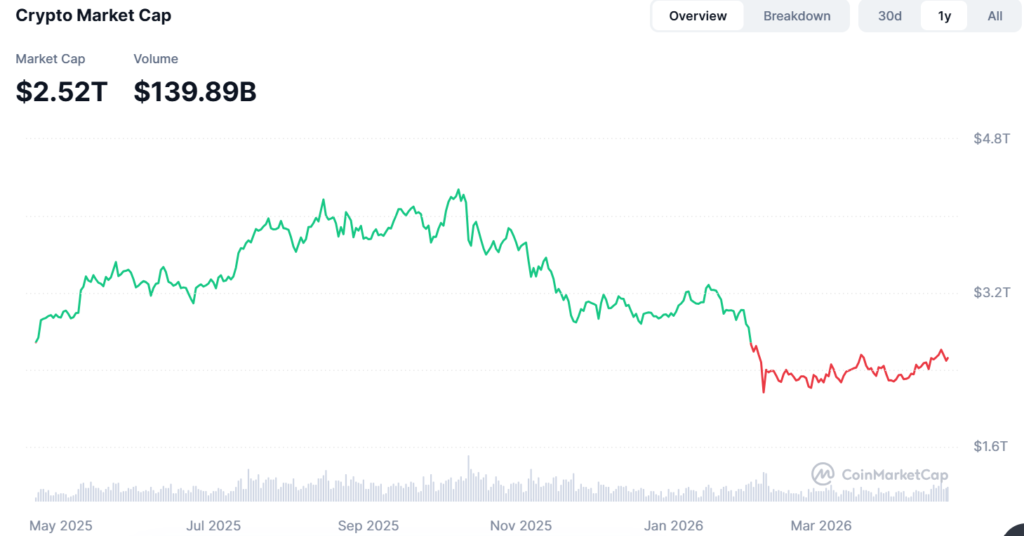
The overall crypto market cap stays flat at roughly $2.6 trillion, down more than $100 billion from its Friday peak.
Markets still waiting for optimism
Elsewhere, the larger stock market has lost ground as well, with Dow Jones falling over 0.3 percent. Analysts explain that the Fed’s capacity to change course has been hampered by energy and transportation challenges caused by current geopolitical unrest, which also increase expectations for future easing. As a result, real liquidity circumstances and rate path expectations vary. Risk assets are not only under pressure in such a setting; rather, they enter a repricing phase characterised by tighter liquidity and residual expectation support, with market behaviour becoming more event-driven.
The cautious approach is currently being mirrored by the larger crypto sector as well. According to Bloomberg, financing rates on perpetual futures have been negative for around 46 days in a row. Comparable only to the aftermath of the FTX cryptocurrency exchange crash in late 2022, this is one of the longest periods of pessimism in the history of derivatives.
In an effort to prevent a breakout, traders are aggressively accumulating short bets. This produces circumstances that increase the likelihood of a short squeeze if the upward momentum continues.
In the last 24 hours, 148,786 dealers have been liquidated, totalling $428.40 million. The greatest single liquidation order occurred on Binance – BTCUSDT for $9.63 million.